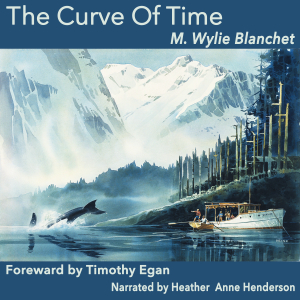


More than six decades after its first publication in 1961, The Curve of Time remains one of the most beloved books ever written about the coast of British Columbia. Part memoir, part travel narrative, and part meditation on memory and place, the book has achieved a rare status in Canadian literature: it is both a regional classic and a work with universal appeal. Readers continue to discover it generation after generation, drawn by its vivid descriptions of the Pacific Northwest, its portrait of family life and adventure, and the remarkable personality of its author, M. Wylie Blanchet. Through numerous editions—including anniversary editions, expanded editions, and illustrated editions—The Curve of Time has achieved the status of a regional classic and continues to attract new generations of readers.
Born Muriel Wylie Liffiton in Montreal in 1891, Blanchet was an intelligent, independent-minded woman who defied many of the expectations placed upon women of her era. She married Geoffrey Blanchet while still young and eventually moved west with her family to Vancouver Island, a remote and isolated area at that time. Her life changed dramatically in 1926 when her husband disappeared and was presumed drowned after taking their small boat, the Caprice, out alone. Suddenly widowed at the age of thirty-five, she was left to raise five children on her own.
After her husband's death, Blanchet needed ways to support her family. During the winters she lived on Vancouver Island, home-schooling her children and writing articles for magazines. She contributed to publications such as The Rudder, Pacific Yachting, Blackwood's Magazine, and others. She also supplemented her income by renting out her Vancouver Island house during the summer months while the family lived aboard the Caprice. This arrangement was both practical and ingenious, allowing her to reduce expenses and generate income while pursuing the coastal adventures that inspired her writing.
Her choices were highly unconventional, especially for a woman in the 1920s and 1930s. Each summer, Blanchet loaded her five children onto the twenty-five-foot Caprice and spent months exploring the intricate waterways between Vancouver Island and the British Columbia mainland. Blanchet served as captain, navigator, engineer, cook, teacher, and mother. Her children became her crew, and together they spent as many as four months each summer exploring the coast.
Roads were scarce, communications were limited, and many settlements could only be reached by water. Much of the Inside Passage consisted of remote coves, logging camps, Indigenous villages, fishing stations, and the occasional homestead. For modern readers, it can be difficult to appreciate how disconnected many parts of coastal British Columbia were during this period. Travelling through these waters required practical seamanship, courage, and a willingness to face fog, storms, tides, rapids, and mechanical breakdowns far from assistance.
These voyages continued for roughly fifteen years and formed the basis of The Curve of Time.
One reason for the enduring popularity of The Curve of Time is Blanchet's distinctive writing style. Although the book recounts real events, it does not read like a conventional travel narrative or sailing log. Blanchet herself observed that it was "neither a story nor a log" but rather a collection of memories gathered across many summers. Her narrative moves freely through time, often linking experiences by theme or association rather than chronology. The result is a memoir that feels intimate and reflective rather than strictly documentary.
Her prose is graceful, intelligent, and deeply observant. She writes about landscapes, tides, wildlife, Indigenous villages, settlers, hermits, and fellow mariners with equal curiosity. There is a sense of wonder throughout the book, but also a calm confidence born of familiarity with the coast. Blanchet had an unusual ability to blend practical knowledge with philosophical reflection. A description of navigating a difficult channel might lead naturally into musings about history, memory, or the passage of time. The title itself derives from contemporary theories about the nature of time and reflects her interest in larger philosophical questions.
Another striking feature of her writing is her modesty. Blanchet rarely places herself at the centre of the narrative. Instead, she allows the landscape, her children, and the people she encounters to take prominence. Biographers have noted that she often appears almost as a shadowy presence within her own stories. Yet her character emerges indirectly through her observations: curious, resilient, humorous, and remarkably independent.
Heather Henderson’s narration reveals a remarkable simpatico with Blanchet. Rather than imposing a dramatic performance on the text, Henderson adopts a calm, reflective cadence that mirrors Blanchet’s own voice—thoughtful, observant, and quietly adventurous. Her narration allows listeners to feel as though they are accompanying Blanchet and her children through the inlets and islands of the Pacific coast. Reviewers have noted that Henderson’s clear, measured delivery meshes naturally with the memoir’s dreamlike and timeless quality, while her careful handling of Indigenous place names demonstrates a respect for the landscape that is central to Blanchet’s vision. The result is a narration that feels less like an interpretation than a continuation of the author’s sensibility, conveying the same affection for the coast, curiosity about its people, and reverence for its beauty that animate the original work.
When The Curve of Time first appeared in 1961, its publisher did little to promote it, and Blanchet died only months after publication, never knowing the influence it would eventually achieve. Nevertheless, readers discovered the book and passed it on to others.
Today, M. Wylie Blanchet is remembered not only as a gifted writer but also as a remarkable individual whose life challenged convention. Widowed young, raising five children alone, navigating remote coastal waters, earning a living through writing, and creating a literary classic almost by accident, she embodied a spirit of independence that continues to resonate. The Curve of Time endures because it offers more than adventure. It captures a vanished coastal world, celebrates curiosity and self-reliance, and reminds readers that exploration can be as much about the inner journey as the outer one. Few books have preserved the character of coastal British Columbia so vividly, and few authors have done so with such quiet elegance as M. Wylie Blanchet.
YOUR GUIDE
FREQUENTLY ASKED QUESTIONS
1: How do I access the audios?
After you register for the audio program, you will be instructed to download the Soundwise mobile app. When you sign in on the app, the program you registered for will automatically load in your library.
2: Can I listen offline?
Yes. Tap on the download icon next to an audio track will download the track to your phone. Simply download the audios when you have wifi and you can listen to them anywhere you go.
3: What should I do if I have technical issues?
Check out common troubleshooting tips here. If the issue is not resolved, please write to support@mysoundwise.com.